

Imagine standing in a kitchen that has seen better decades, staring at a countertop that has a permanent ring from a coffee mug and a cabinet door that hangs by a prayer. You want to fix it. You really do. But then you look at the contractor’s estimate, the sudden price of lumber, and the realization that your savings account isn’t quite ready for a full overhaul. This is where most homeowners find themselves staring at a crossroads of financing options.
The direct answer is that home improvement loans are typically unsecured personal loans designed to cover the costs of renovations, repairs, or general upgrades. They allow you to borrow a lump sum of cash without putting your house up as collateral. While they are incredibly convenient for quick projects, they aren’t the only way to fund a dream renovation, and choosing the wrong one can end up costing you more in interest than the actual construction work.
Choosing the right path requires looking at how much you actually need. If you are just replacing a leaky faucet or painting a room, a small personal loan works fine. However, if you are planning a massive addition that adds significant square footage, the math changes entirely. You have to weigh the speed of a personal loan against the potentially lower interest rates of home equity products.
Many people make the mistake of rushing into the first offer they see online. It is tempting to grab the first line of credit that pops up in an advertisement, but that’s a recipe for high-interest debt. You need to compare rates and terms carefully to ensure you aren’t paying a premium for the convenience of speed.
Unsecured Loans vs. Tapping Into Your Equity
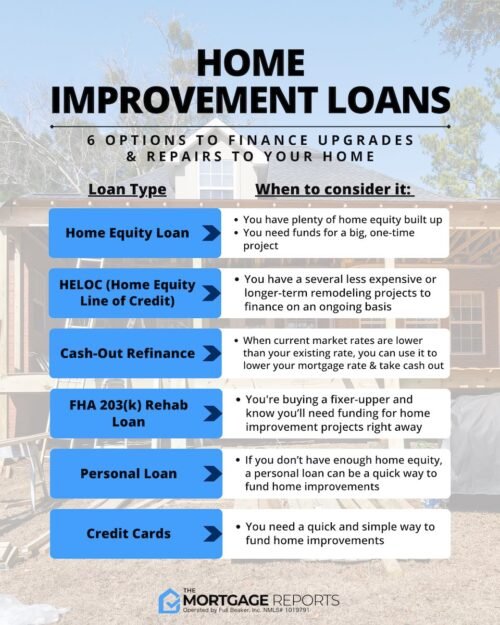
When most people talk about “home improvement loans,” they are often referring to unsecured personal loans. These are straightforward. You apply, you get approved based on your credit score and income, and the money hits your bank account. Because the bank isn’t taking your house as a guarantee, they charge a higher interest rate to cover their risk. It is a trade-off: you get the cash fast, but you pay more for the privilege of not risking your roof.
On the other side of the coin, you have home equity-based options. This includes Home Equity Lines of Credit (HELOCs) and Home Equity Loans. These are secured by your property. Because the lender has your house as collateral, the interest rates are usually much lower than personal loans. This makes them a favorite for large-scale projects like adding a sunroom or finishing a basement. However, there is a significant catch. If you fail to pay back a HELOC, the bank can foreclose on your home. That is a heavy weight to carry while you are just trying to update your bathroom.
There are also credit cards in the mix. Some people use high-limit credit cards to pay for small renovations, especially if they can pay the balance off within a promotional 0% APR period. If you miss that window, the interest rates on a credit card will dwarf any personal loan rate you could find. It is a high-stakes game. You have to be disciplined. If you aren’t someone who pays every cent of your credit card bill every single month, stay far away from using them for home projects.
The choice often comes down to the scale of the work. For smaller, “quick fix” projects, a personal loan is often the most logical step. For massive structural changes, equity is usually the smarter financial move. Many homeowners find themselves using a mix of these tools to bridge the gap between their savings and the total project cost. It’s a balancing act that requires a clear head and a very realistic budget.
Before you sign anything, consider your long-term goals for the property. If you plan to move in three years, a long-term home equity loan might be a headache you don’t need. If this is your forever home, the lower rates of equity-based financing might save you thousands over the next decade. You should check 2026 Home Improvement Loan Reviews to see how different lenders are currently pricing these different types of debt.
Comparing the Financing Landscape
To make an informed decision, you need to see how these options stack up side-by-side. It isn’t just about the interest rate; it is about the total cost of borrowing and how much flexibility you have during the construction phase. A renovation often hits “surprises”—the plumber finds rot behind the wall, or the tiles you loved are suddenly backordered for six months. Your financing needs to account for that volatility.
The following table breaks down the general characteristics of the three main contenders for renovation funding:
| Feature | Personal Loan | HELOC | Home Equity Loan |
|---|---|---|---|
| Collateral | None (Unsecured) | Your Home (Secured) | Your Home (Secured) |
| Interest Rate | Higher | Variable (usually) | Fixed (usually) |
| Approval Speed | Fast (Days) | Slow (Weeks) | Slow (Weeks) |
| Monthly Payment | Predictable | Fluctuates | Predictable |
Personal loans are excellent for those who want a fixed monthly payment and don’t want to mess with their home’s title. You know exactly what you owe every month, and the lender doesn’t care if the renovation goes slightly over budget or under budget. It is a clean, simple transaction. You get the money, you do the work, and you pay it back. There is a certain peace of mind that comes with that simplicity.
HELOCs act more like a credit card. You only pay interest on the money you actually spend. If you have a $50,000 line of credit but only spend $10,000 on a new deck, you only pay interest on that $10,000. This is incredibly efficient for phased renovations. You can do the deck this summer and the patio next summer without having to re-apply for a loan every single time. However, the variable interest rate is the danger zone. If rates spike, your monthly payment spikes too.
Home equity loans are the “old school” option. You get a lump sum at a fixed rate. It’s great for stability. If you have a very specific, fixed-price contract from a contractor, this is a very safe way to fund it. You won’t have to worry about market fluctuations or changing your budget halfway through. You just need to ensure you aren’t borrowing more than the house can actually support once the work is done.
The Hidden Variables in Borrowing
It is easy to get lost in the numbers, but the math on paper rarely tells the whole story. There are several “soft” costs and procedural hurdles that can make or break your renovation budget. Many homeowners forget that the loan itself isn’t the only expense. You might find yourself needing to pay for appraisals, inspections, or application fees that can add hundreds, if not thousands, to your initial costs. Always ask for a complete list of closing costs before you sign.
Credit score is the king of the realm here. Your score dictates whether you get the “good” rates or the “avoid at all costs” rates. If your score is hovering in the high 600s, you might find that the personal loan rates offered to you are actually higher than a credit card’s standard rate. That’s a frustrating spot to be in. You might want to wait a few months to boost your score before applying for any significant amount of debt. It can save you a fortune in the long run.
If you are looking for more specific guidance on the current market, you can check Best Home Improvement Loans of August 2026 to see how lenders are behaving. The market changes quickly. What was a great deal in July might be a bad deal by September. Don’t be afraid to shop around, even if it feels like a chore. A 1% difference in your interest rate might not seem like much on a brochure, but over five years, it’s a significant chunk of change that could have gone toward a better backsplash or a nicer faucet.
Another factor is the “purpose” of the loan. While many lenders market these specifically for home improvements, most personal loans are “multi-purpose.” This means you can technically use them for anything, debt consolidation, a vacation, or a new car. However, if you are using a home equity product, you must be much more careful. Using home equity for something other than home improvement is a risky move that many financial advisors suggest avoiding at all costs. You are essentially gambling your house on your ability to pay off a vacation.
Finally, consider the timeline of your project. Renovations almost always take longer than you think they will. If you take a loan that has a very short repayment term to save on interest, you might find yourself struggling to make payments while the contractor is still half-finished with the work. It is vital to coordinate your loan’s term with the expected lifecycle of the project. Don’t squeeze yourself too tightly. Give yourself some breathing room. It’s better to pay a little more in interest than to default on a loan because your kitchen is a construction zone for six months longer than expected.
Preparing for the Application Process
Walking into a bank or clicking “apply” online requires more than just a good credit score. You need to be organized. Lenders are going to want to see proof of income, tax returns, and a clear understanding of what you plan to do with the money. Even with unsecured loans, having a written estimate from a professional contractor can make you look much more reliable. It shows the lender that this isn’t a whim, but a planned expense.
When you are reviewing your options, keep a spreadsheet. It sounds tedious, but it is the only way to compare apples to apples. You cannot easily compare a 5-year personal loan with a 10-year home equity loan just by looking at the interest rate. You have to look at the total amount of interest you will pay over the life of the loan. This is where the true cost of the renovation becomes clear. Sometimes, the “expensive” monthly payment of a short-term loan is actually the cheaper option overall.
Be wary of “predatory” lenders who promise instant cash with little scrutiny. If a lender doesn’t care about your income or your credit, they are going to make up for it by charging you astronomical interest rates. If it sounds too good to be true, it almost certainly is. Real lending is a math problem, and if the math doesn’t add up for the bank, it certainly won’t work for you. Stick to well-known lenders and reputable financial institutions.
One final piece of advice: get a second opinion on your project. Before you take out a single dollar in debt, have a professional contractor look at what you’re planning. You might find that the $20,000 kitchen you were planning can be achieved for $14,000 with better planning. Every dollar you don’t borrow is a dollar you don’t have to pay interest on. Being smart about the construction side of the equation is just as important as being smart about the financing side. It’s a two-part dance, and you need to master both steps before you start moving.
Renovating a home is an emotional process as much as a financial one. It’s about your sanctuary and your investment. Take your time, do the math, and don’t let the excitement of a new floor drive you into a debt trap you can’t escape. If you approach the financing with the same care you use to pick out your new countertops, you’ll end up with a home you love and a financial situation that remains stable. For the full picture, it’s worth checking texasloanstoday.com.